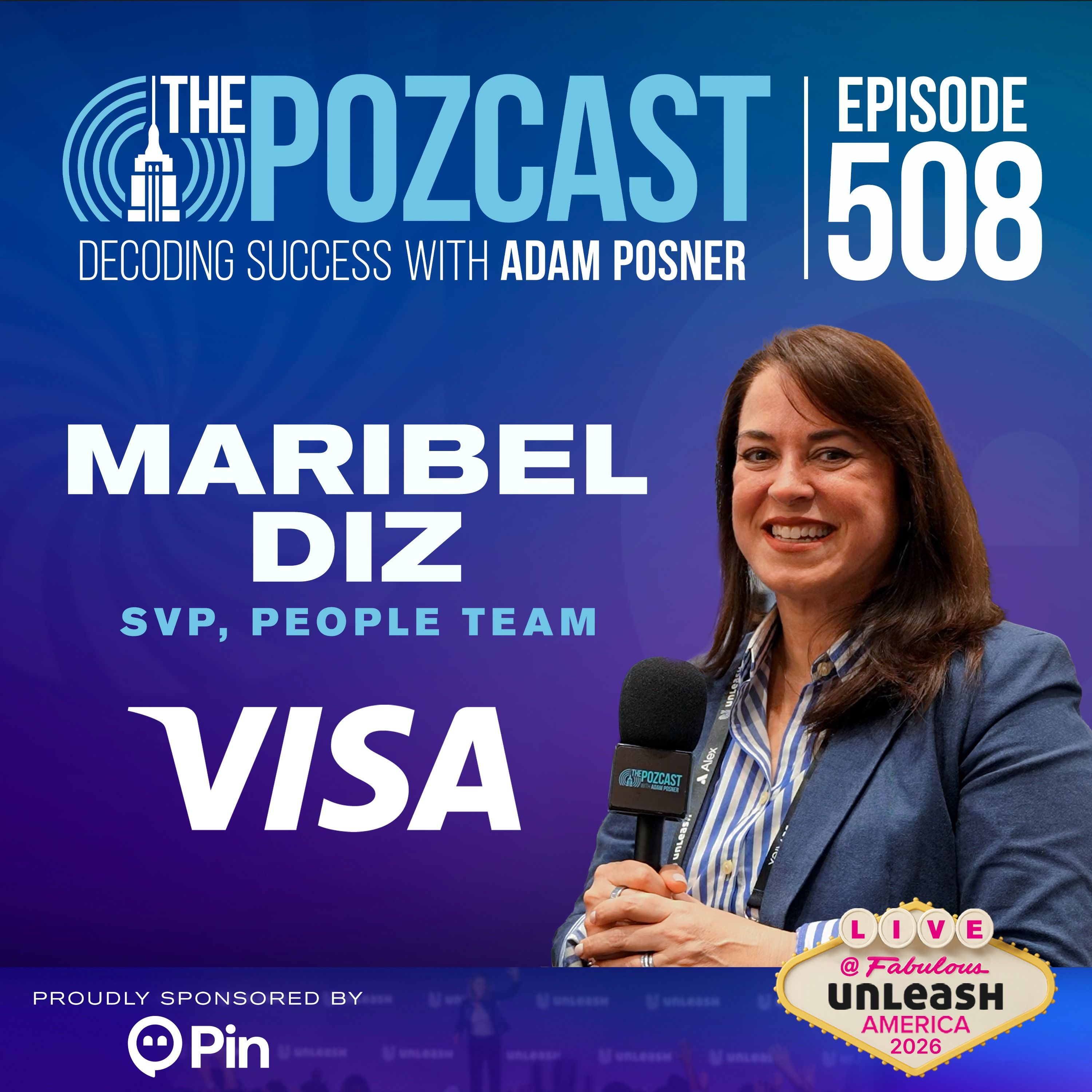
Inside the Future Workforce with Visa’s HR Leader: Maribel Diz (LIVE @ Unleash 2026)

WATCH: https://youtu.be/MwTk4g91WLY
Live from UNLEASH 2026, Adam sits down with Maribel Diz, SVP of People at Visa, to explore how leadership, culture, and career development are evolving in a multi-generational workforce. With nearly 30 years at Visa, Maribel has seen the company—and the world of work—reinvent itself multiple times. Her perspective blends real-world leadership with academic research, offering a grounded yet forward-looking view on what today’s workforce needs. At the center of the conversation is the shifting dynamic between generations—particularly the rise of Gen Z. Maribel challenges common misconceptions, arguing that Gen Z is not entitled or disengaged, but instead highly capable, digitally native, and deeply motivated. What they need isn’t hand-holding—it’s guidance, structure, and leadership that meets them halfway. She shares insights from her doctoral research, including how Gen Z processes information, what drives their engagement, and why traditional leadership approaches often fall short.
The conversation also tackles one of the most debated topics in today’s workplace: Remote work vs. in-person work. Maribel offers a clear and nuanced perspective—while remote work may provide flexibility, in-person environments create the relationships, visibility, and unspoken learning moments that accelerate careers. “If you want a job, you can work remotely. If you want a career, you need to come into the office.” She also highlights how AI and automation will reshape HR, freeing leaders from tactical work and enabling a greater focus on strategy, talent development, and mobility. This episode is a practical and optimistic look at the future of leadership—one that requires empathy, adaptability, and a deeper understanding of what truly motivates people.
Connect with Maribel: https://www.linkedin.com/in/maribel-diz-dba-0858856/

 Apple Podcasts
 Spotify
 Castro
 RSS Feed
 These episodes of #thePOZcast, live from Unleash 2026 in Las Vegas, are proudly brought to you by our friends at PIN. AI recruiting tools that automate candidate sourcing, screening, and scheduling across 850M+ profiles. Built for recruiters, agencies, and hiring teams.
Learn more and check out a demo: https://www.pin.com/book-a-demo?via=adam-posner
Thanks for listening, and please follow us on Insta @NHPTalent and www.youtube.com/thePOZcast
For all episodes, please check out www.thePOZcast.com
About:
Maribel R. Diz is the Head of People for Latin America and the Caribbean Region at Visa. She is responsible for developing and executing people strategies in support of the overall business plan and direction in the region. She is also a strategic business advisor to the Visa Latin America and Caribbean leadership team regarding talent needs and plans for the region, including Miami, Argentina, Brazil, Mexico, Chile, Colombia, Costa Rica, the Dominican Republic, Ecuador, Guatemala, Panama, Peru, Puerto Rico and Venezuela. She has also served as the global People Champion, serving as the Chief People Officer’s advisor, enabling her to work closely with the global People community in meeting the strategic priorities of the function. Maribel has more than 25 years of experience with Visa, and has a proven track record of working very closely across functions and geographies, providing leadership and driving change in the organization, while also promoting the Visa culture and leadership principles with diversity and inclusion across the region. She specializes in transformational work focusing on creating high performing leadership teams.
Maribel has a Masters of Science in Human Resources Management from Florida International University and an undergraduate degree in Business from Nova Southeastern University. She also holds a Doctoral in Business Administration with distinction at Florida International University. She sits on the Center of International Business Education and Research, and Masters in Human Resources advisory boards at FIU, and was recently appointed as a Co-chairperson of the Doctoral in Business Administration Advisory Council. She is an active role model for HISPA (Hispanics Inspiring Student’s Performance and Achievement) speaking to high school students inspiring them to stay in school and follow their dreams. She is a published author and accomplished speaker on all things leadership and gender inclusion, and is also specialized in the different workplace generations.
CHAPTERS
00:00 Opening + final interview from UNLEASH
01:00 Intro to Maribel Diz (Visa HR Leader)
02:30 30-year career at Visa: why she stayed
04:30 Career growth, promotions & confidence
06:00 Generational shifts in the workforce
08:30 Gen X vs Millennials vs Gen Z dynamics
10:30 Why Gen Z is misunderstood
12:00 What Gen Z actually needs from leaders
14:00 Leadership strategies for younger talent
16:00 Remote work vs in-office debate
18:00 “If you want a career, come into the office”
20:00 The value of proximity, visibility & relationships
22:00 Hybrid work realities across global teams
24:00 HR tech & AI: what’s actually exciting
26:00 Using AI to remove tactical work
28:00 The future of HR as a strategic function
30:00 Leading with personalization (not one-size-fits-all)
32:00 What truly motivates Gen Z and millennials
34:00 Research insights: how Gen Z processes information
36:00 Attention myths vs reality
38:00 Motivation vs inspiration in leadership
40:00 Preparing for the future workforce
42:00 Final advice for leaders and organizations
43:30 Closing + where to connect
KEY TAKEAWAYS
- Gen Z is not entitled—they are highly capable but require guidance and context
- Leadership must shift from one-size-fits-all to personalized development
- Remote work offers flexibility, but in-person work accelerates career growth
- Relationship building and visibility remain critical for long-term success
- AI will remove tactical HR work and elevate the importance of strategic leadership
- Motivation is internal—but inspiration must come from leadership
- Generational differences are less about conflict and more about understanding
- The future of work requires meeting employees halfway while maintaining standards
at 6:00, which actually wasn't- That's not badbut it was, but I was still up at 4:00 in the morning thinking of taking the 7:00 AM flight.Yeah.So I got to the airport anyway 'cause that's where my ride was, and I just worked in the Chase lounge.Sorry, the other credit card lounge.Well, it'sIt is a Visa.Isn't it Chase?It is.Yes.We're okay.And we're ready to rock and roll in 3, 2, 1.We are back, and this is the final interview of Unleash 2026 here on the podcast, and we have a good one for you, folks.I waited for my friend Maribel here.We waited because she's working on something, working on a deck, working on her presentation.Travel was a pain in the butt, but we got here.It was, but we're here.We're here.Exactly.So why don't you just quickly introduce yourself, tell everyone who you are and what you do over at Visa.Hi.My name is Maribel Diz.I'm the senior vice president of people for the Latin American and Caribbean region.How long you been with Visa for?Next month, it will be 30 years.Wow.So we, going a little off-script here, but I think this is a fair question.What do, what do you love most about working at Visa?It's kept a m- long- Exactlylike, we're, we're kinda moving away for this day and age of people staying at companies and having such long tenures.What, what keeps you there?I'll tell you.When I started this gig, I thought I was gonna be here for 3 years, like Gen Xers did.Right.But the company is just so amazing.It reinvents itself every, I would say, 3 years.It's at the cutting edge.It's super innovative.It's so dynamic I've made a great career out of it, and here I am.Love it.I love it.What, what has evolved about your job as you've progressed through the ranks that you love?You know, it's funny, because at the beginning of my career, I would get promoted, and I would never think I was qualified for the job, but someone else did.Little imposter syndrome.No, let's not call it that.What do you wanna call it?I'm, I'm starting a movement.Well, I don't like imposter syndrome.I just felt it was the right thing to call it.I'm gonnaI'm g- it is.It is because it's, it's become a cliche term.Oh, it's so overused.And we're gonna, we're gonna put it on its head, because as a scholar, imposter syndrome is a term that h- is being used very loosely.It is very serious, and what we want to say is that the folks sitting at the table don't believe that they belong there, and let's keep it at that.Because if we label it imposter syndrome, it's something else.We could have a whole sidebar on that because I'm on the same page as you.I think it was an expression that people latched onto as an excuse for- Yeahunderperformance.Became a trend.But- Yepwe're gonna move on from that.So you oversee a region spanning many cultures and economies across Latin America and the Caribbean, I think Miami as well.When you look at the growing presence of Gen Z and millennials in those markets, what is the most meaningful way that their expectations of work differ than previous generations?Well, I don't know what generat- you, you look like a millennial to me.One lower.I'm a X-er.I'm a Gen Xer.Me too.Oh, really?I'm '79.Okay.All right.Um, yeah, you're on a c- you're on the cusp.I know, but I- You're on a weird cuspbut I'm more, I consider myself, like, from a culture and music standpoint, like, I feel like I could've been born in, like, '75, '76, but I happen to be '79.All right.So you're an honorary Gen Xer.You know, when- I, I'm a millennial, whatever they wanna call itwhen we started, um, in our careers, it was sink or swim.No one really told us what we had to do.We had to figure it out.And when the millennials entered the workforce, it was something quite different, and, and they clashed a lot with the, with the Gen Xers, but they were loved by the baby boomers.Mm.And you know why?Because baby boomers are the parents of the millennials, so they had that simpatico syndrome going on there.So what, what we Gen Xers struggle with is the, what we think is hand-holding.Or we call it entitlement, whatever we wanna call it.Uh, yeah, you know, and, and especially, especially Gen Z-ers, they get a bum rap.They're getting a lot of hate these days.I agree.And I, and I'm so sad because you know what?They're so great that they're gonna leapfrog the millennials- How so?because they're just so digitally savvy.That's the thing.It's native.It's incredible.And they're, they're true digital natives.Their brain made the connections early on that ours didn't, and, and they're just so, so good.And what they need is they just need some, some love- So-some kindness, and some guidance.So how do we give it to them?I have a whole training on that-because my dissertation when I got my doctorate was on Gen Zs and millennials- What a fun thing to work onbut more, more, more towards the Gen Z.And, and what I found, and I'm gonna talk about it at the main stage tomorrow, is that they, um, are looking for an extension of their parents at work, and that's very, very scary for leaders because they're like, "We don't wanna do that."But there are some tricks in order to- Okay, well, let's talk about that.How does modern leadership manage a cross-generational workforce, specifically in the, with the Gen Z being the- Yeahthe lion's share of a workforce at this point?Yeah, yeah.Um- And millennials.And millennials, let's not forget them.So the millennials, they're, they're grown up.They're, they're pretty much on their own.They have mortgages to pay.They pay taxes, kids, you name it.So let's, let's focus on the Gen Z a little bit because these are the up-and-comers, which by the way, they understand the Gen Xers because we're their parents, and we, we understand them, and they know how to manipulate us.Oh.So- We could talk about how I get manipulated by my seven and 13-year-olds, yes.We will, and I've got some tricks for that too.But it, it's, it's going to be second nature for these Gen Xers to lead the Gen Z-ers because they, they get them, they understand them.But I feel that we need to meet in the middle because a lot of their-Their expectations are unrealistic.This is probably their first or second job, and they need to get a taste of the corporate world.So we need to meet halfway with them.We need to train them, we need to educate them, and they are ready.They want to learn, and they want to please as well.So i-i-it's gonna be great.I, I'm very optimistic about this.Um, off-script hot take here, as much as you feel comfortable talking about in, in general.COVID forced a lot of companies to go remote.How much of that has affected the younger workforce?And, and do you feel like they're really missing something about being- I doin an office or like- I do"Hey, listen, this is a new, a new dawn, a new day.Companies need to be adaptable to more remote."Okay, this is Maribel Diaz speaking here, not representing Visa.Um- This is notYes.You wanna do a little disclaimer?Um- I, I might have to.Okay.So what I like to say, and what I've proven to be true is, if you want a job, you can work remote.But if you want a career, you need to come into the office because a lot of things happen in the office.Things that you don't, aren't in an email.It's this.It's the, it's this.The body language.I can't even- It's connect-imagine how many things when you were younger, and I were younger, career, like, watching the senior level folks.They're, they're, the way they- Yestheir, their, their posture.I mean, I worked in advertising, like the way they commanded a room, the way they commanded respect and attention.Weren't we supposed to do that over Slack or Zoom?Yeah.No.A-and it's, and the, and sometimes if you have your camera off, you miss a lot, and the connections.We're, humans long for that social connection.And, and I, not because I'm a Gen X-er, but I have 2 Gen Z-ers at home, and I tell them all the time, "Guys, if you want a career, go into the office."And my, my daughter, who's 28 and killing it in her corporate job, little girl boss, she sees it and she gets it, and she's climbed that corporate ladder faster than she would have if it would've been purely remote.And they see the value of it, and I think it's, it's a tough one 'cause I don't wanna say anybody who wants to work from remote only is lazy 'cause I don't think that's the case at all.No, it's not.I think that the real thing is shifting that conversation to understanding the value, and I'm not saying everyone has to be in work 5 days a week.But that time you spend with your coworkers is, even if it's not on productivity time, it's relationship building.It's relationship building.It's connecting with them.Exactly.It's collaboration.It's sharing- Yesyou know, of, of, of mindset there and, and there's a, there's obviously debates, and obviously there's some roles that can be remote, right?And then you have the whole- Absolutelycommuting conversation as well, and as you become older and you have a family, y- the, the time shifts.How do you, if you don't mind me asking, is, is your team on site?Is it remote?Is it a mix?Is it a hybrid?Well, I manage a region, so- And you have a very lo- so generally speaking- Generally speaking-do you have folks that are remote?Abso- well, they're not remote.They're in the market in, in a Visa office.Okay.So they're- So they're, I, I supervise them remotely, but they're in an office, and it's a matrix.So we have someone on the ground that they interface with and me, but the majority of my team sits near me.Interesting.So you as a leader, as you've moved up the ranks, you know, in this world, you've seen technology change.What, what about the, the tech- the, the, we look around this room here.There's a, a million vendors there.Generally speaking, what gets you excited about the technology in the TA and HR space?Oh my gosh.I, I just, I, I feel that our job is gonna get so much easier because the tactical stuff is going to come off our plates, and it's gonna give us that opportunity to think strategically, to engage with our senior leaders, to really design and develop things that matter, like how do we focus on our talent?How do we continue to grow our talent?How, how do we move our talent around?How do we get them those- Mobilityexperiences in order to make them stronger and stay with the organization?Um, and a lot of thi- pe- people are a bit, um, sheepish when it comes to parsing things out to, to AI, but I would say embrace it.Y- give it what you don't wanna do.Lean in.Give it what you don't wanna do.It's liberating.I ag- I love, I love how you said that.And, and what I, what I tell everybody is if you want to learn about something, you do it.Yep.You try it.Try it for something personal, like, try to give it a test.Try toThink about things that aren't work-related that you could give it a shot to.Yeah.Try it with your finances.Have it ingest all of your credit card statements or your bankWell, be careful there.But I'm saying, give it some numbers or give it some generalizations.Here's our monthly budget.Have it plan your trip.Here's how much you're allocating.Oh, my, we, we went to Hawaii.We had to plan our trip for us.We had to give us advice.There's so many ways here.So, uh, Maribel, looking ahead, 5 to 10 years as Gen Z becomes this dominant cohort in the workforce, across your region, where do you believe organizations need toWhere do you think they need to rethink about how they lead and develop talent?first of all, these generations are intrinsically motivated, so it's not one size fits all.You really need to get to know your talent.You really need to get to know what moves them, and then you take that and you shape it into an interesting project.You explain to them how this is going to make an impact, and strategically speaking, they mobilize very well.They do.And we can really take advantage of them.I want you to leave us with some wisdom from your working towards your doctorate and your dissertation, what's a big aha moment from your research that maybe you really don't get a chance to talk about a lot, something that you think leaders need to hear now about the future of building the workforce?I love it.Well, in my study, um, there were a lot of aha moments, and I'll leave you with 2.Please.Number one.We love a bonus aha.Number one.It's an aha aha.Gen Xers are visually distracted.What?Exactly.But these generations are audibly distracted, so that's why they plug in.That's why they wear headsets, because if they don't, they get distracted and they can't focus, and boy, can they focus.There's a, you know, another myth out there that the attention span is up there.False.They can focus, and they can focus deeply.You have to weed out the noise, right?TheyYeah.Yeah, itHappy birthday.If we see a cake, we're there.We want- I thought you were wishing me happy birthday.My birthday was a couple weeks ago, so thank you.Happy birthday.But if they hear the singing of happy birthday, that'sNot, not the visual- It's the triggerit's the, it's audible.And the other thing that I, that Iwas another aha moment is that leaders thought that these 2 generations were longing for motivational leadership, and that's not true.It's inspirational leadership.Mm.And the difference between the 2 is they motivate themselves, but they need to look up to someone.They need to respect someone that will inspire them.It's more of that pushing towards something than them pulling.Oh, I love that.That's a good stuff here.Well, thank you for inspiring us, Maribel, with your inspirational leadership.It's been an absolute pleasure.Thank you to our friends over at Visa for setting up this conversation here.Where could folks find you?Where could they connect?Where could they learn more?What was that?Where could folks connect with you?Where do you prefer forWhere do you prefer to engage on social media?LinkedIn.LinkedIn's where it's at.Maribel Diaz, thank you.Thank you.Pleasure.Awesome.Great.Oh, good.Thank you very much.I'm glad- Thanks for coming.I'm glad we made it happen, and your team has been fantastic.All good.Um, hyper- Photos and videos Thank you.Yeah.Hyper, hyper-responsive and a pleasure to collaborate with.All right.One little-